
NBA Prop Picks and Expert Prediction Methodology
 Available in US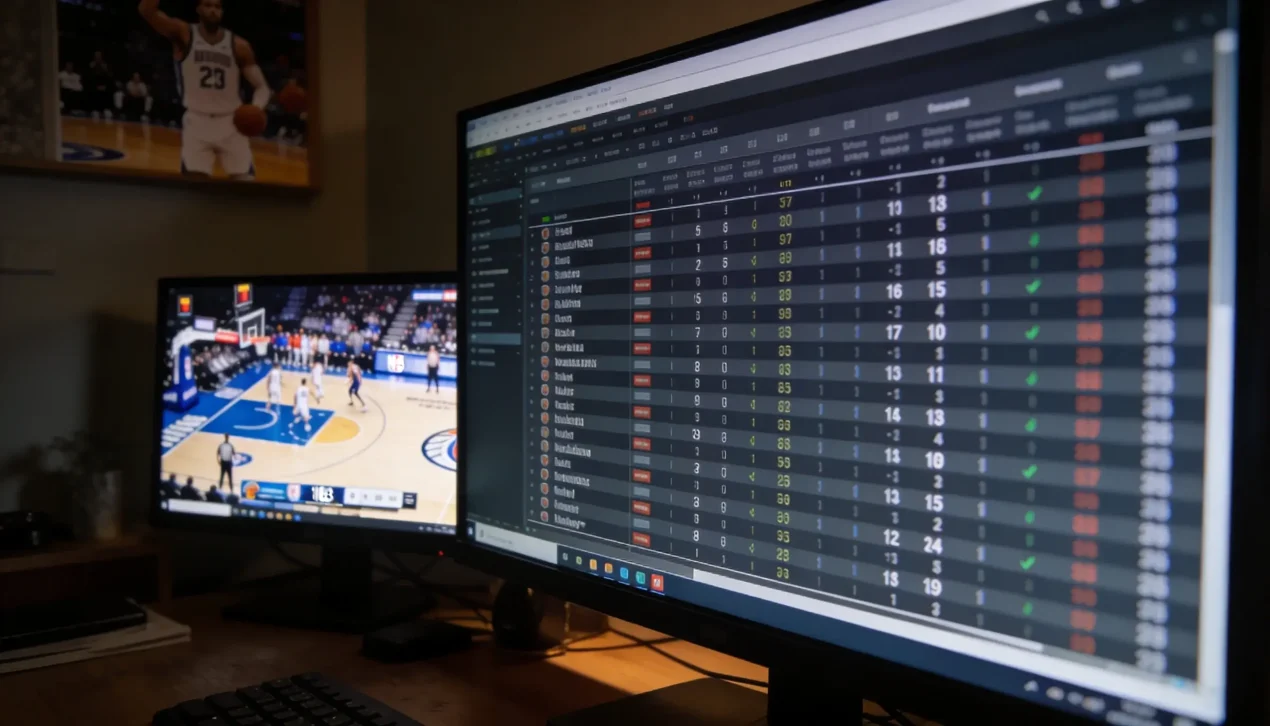
Evaluating Prop Picks: How to Differentiate Genuine Expertise From Guesses
Three years ago I followed a tipster on social media who posted NBA prop picks every afternoon with a claimed 67% hit rate. His screenshots looked impressive — green tick after green tick. I tailed him for a month, tracked every pick in a spreadsheet, and his actual hit rate over that period was 48%. The screenshots were real; they were just cherry-picked. He posted the wins, quietly deleted the losses, and let confirmation bias do the rest.
That experience changed how I evaluate any prop prediction, including my own. The NBA prop picks landscape is enormous: bookmakers now set 200 to 250 individual player prop lines on a typical game day, and dozens of sites, podcasts, and social media accounts offer selections on those lines every evening. Some are backed by rigorous models. Some are backed by nothing more than a confident tone. The difference between the two is not always obvious from the outside, which is exactly why understanding methodology matters more than following results.
Player proposition bets now represent 25-30% of all basketball wagering handle — a share that has nearly doubled in three years. As the market grows, so does the volume of people selling picks into it. Before you stake real money on someone else’s analysis, you need a framework for separating signal from noise.
Simulation-Based Picks: 10,000 Runs and What They Tell You
The most credible prop prediction services lean on Monte Carlo simulations — running a game thousands of times through a statistical model that accounts for player usage, matchup data, pace, and injury context. Services like SportsLine advertise 10,000 simulations per game, and the output is a probability distribution for each player’s stat line.
What does that actually mean in practice? Imagine you want to know whether a guard will go over 22.5 points. The model plugs in his shooting splits, the opponent’s defensive rating at his position, the expected pace of the game, his usage rate with and without certain teammates on the floor, and then runs the scenario 10,000 times with randomised variance. If the player exceeds 22.5 in 5,800 of those runs, the model assigns a 58% probability to the over. Compare that to the bookmaker’s implied probability — say 52% after stripping the vig — and you have a potential edge.
The strength of simulation models is that they can capture interaction effects that simple averages miss. A player’s scoring output does not just depend on his own ability; it depends on who else is on the court, how fast the game flows, and how the opposing defence is structured. Larry Hartstein, an NBA analyst at SportsLine, captures this well when breaking down playoff matchups — noting how athleticism and energy interact with projected game pace to shift projections away from regular-season baselines.
The weakness is the garbage-in-garbage-out problem. A simulation is only as good as its input assumptions. If the model underweights a coaching change, misclassifies a defensive scheme, or uses stale injury data, all 10,000 runs produce the same systematic error. Treat simulation-based picks as one data point, not gospel.
Form-Based Analysis vs Projection Models
Not every prediction comes from a computer. Some of the sharpest prop analysts I know work primarily from recent form data — the last five to ten games — cross-referenced with matchup context. Their process looks less like data science and more like investigative journalism: watching film, reading practice reports, tracking minute fluctuations.
Form-based analysis has a genuine advantage in fast-moving situations. When a starting point guard goes down with a sprained ankle two hours before tip-off, a projection model needs time to recalibrate. A form-based analyst who has been watching the backup’s minutes trend upward over the past week can react almost immediately. That speed creates a window where the bookmaker’s line has not yet adjusted, and the form analyst has an informational edge.
The downside is scalability. A human analyst can deeply research three or four games per night. A projection model can cover every game on the slate simultaneously. For a UK punter who works during the day and has NBA games starting at midnight or later, there is a practical question of bandwidth: do you have time to do the deep-form work yourself, or are you better off using a model’s output as a starting filter and then applying your own context to the shortlist?
In my own workflow, I use both. I start with a quantitative screen — looking for props where backtested win rates diverge most from implied probability, particularly in high-variance categories like blocks and three-pointers where bookmaker error rates are historically higher. Then I apply a form-based overlay: has the player’s role changed recently? Is there a matchup quirk the model might miss? That combination of breadth and depth is, in my experience, the closest thing to a sustainable edge in this market.
How to Evaluate a Prop Tipster’s Track Record
If you are going to follow someone else’s picks — and there is no shame in that, provided you do it with open eyes — here is the checklist I run before I trust a single selection.
First, sample size. A tipster claiming 60% accuracy over 40 picks has proven nothing. Variance alone can produce a 60% hit rate over small samples even with zero skill. I want to see at least 250 tracked picks before I start taking the numbers seriously. Below that threshold, the confidence interval around the claimed hit rate is so wide that it is statistically indistinguishable from a coin flip.
Second, transparency. Every pick should be time-stamped and recorded before the game starts, ideally on a third-party platform. Post-game screenshots are worthless as evidence. If a tipster cannot point you to a verifiable, uneditable record of their selections, walk away.
Third, odds accountability. A pick is only meaningful at the price it was taken. Recommending “Player X over 18.5 points” means nothing if the line has since moved to 20.5. The tipster should log the exact decimal odds at the time of the pick so you can calculate whether there was genuine expected value at the point of recommendation.
Fourth, return on investment over hit rate. A 55% hit rate at average odds of 1.90 produces a different profit than a 55% hit rate at average odds of 1.75. ROI — total profit divided by total amount staked — is the only number that tells you whether a tipster is making money. Anything else is a vanity metric.
Finally, consider whether the tipster’s edge is accessible to you. If their picks are based on early-morning line releases that have moved significantly by the time you see the recommendation, the value has already been captured by someone else. For UK punters, timing matters: NBA lines often shift between the US afternoon and the UK evening, and a pick posted at 3pm Eastern might look very different by 10pm GMT.
The Real Value of Understanding Methodology
I do not sell picks. I analyse props for a living, and the single most useful skill in this space is not finding winners — it is knowing why a pick was made and whether the reasoning is likely to hold in the future. A tipster who hits 58% for a month using a sound, repeatable process is infinitely more valuable than one who hits 65% for a month using gut instinct, because the first approach scales and the second regresses.
When you understand the methodology behind a prediction — whether it is simulation-driven, form-based, or a hybrid — you gain something more important than a single bet: you gain the ability to assess quality in real time. You can spot when a model’s assumptions have gone stale, when a form analyst is ignoring a matchup that matters, or when a tipster’s track record is built on a sample too small to mean anything. That critical eye is what separates a punter who follows picks from one who builds a genuine prop betting strategy.
How reliable are computer-generated NBA prop picks?
Simulation-based picks are only as reliable as the data and assumptions feeding the model. A well-built model that accounts for matchups, pace, usage, and injury context can identify genuine edges — but it will still lose roughly 40-45% of the time on standard player props. No model eliminates variance. The value is not in winning every bet but in consistently identifying positive expected value over hundreds of selections.
What sample size makes a prop tipster’s record meaningful?
At minimum, 250 tracked picks with verified, time-stamped odds. Below that number, the margin of error around a claimed hit rate is large enough that even a 58% record could easily be the result of normal variance rather than genuine skill. Ideally, you want to see a full NBA season’s worth of picks — around 400 to 600 — before drawing firm conclusions about a tipster’s ability.
This material was created by the PROPSWISH team.
Related posts
NBA Prop Bets vs Moneyline and Spread: a Side-by-Side for UK Punters

NBA Race to X Props and Game-Level Propositions: Beyond Player Markets