
Best NBA Prop Bets and Real-Time Odds for UK Punters 2026
 Available in US
Data-Driven NBA Props for UK Punters

UK NBA Prop Bets: Rapid Market Growth and Sportsbook Opportunities
Nine years ago, I placed my first NBA player prop bet from a flat in East London. It was a points over on LeBron James, the odds were wrong by about three points, and I had no framework for understanding why. I just liked the number. That bet lost. The next one lost too. It took me the better part of a season — and a spreadsheet that eventually grew to several thousand rows — to realise that the prop market is not a guessing game. It is the single most inefficient betting market in professional basketball, and UK punters are uniquely positioned to exploit it.
Here is the landscape in three numbers that matter.
25-30% of Handle
Player proposition bets now represent a quarter to nearly a third of all basketball wagering — up from roughly 15% just three years ago. The money flowing into this market has outpaced bookmakers' ability to price it accurately.
GBP 16.8 Billion GGY
The UK gambling industry generated GBP 16.8 billion in gross gaming yield in the year to March 2025, a 7.3% jump. Remote betting — the kind you do from your phone at 1 AM watching a West Coast tip-off — accounts for nearly half of that.
40% Viewership Growth
NBA viewership on Sky Sports has climbed 40% since 2019, driven almost entirely by audiences under 30. More UK eyes on the game means more demand for prop markets, more liquidity, and more opportunities for those who know where to look.
This guide is not a list of tonight's picks. Those expire by morning. What I have built here is the analytical framework I use every day — the same one that turned a losing first season into nine years of consistent, data-driven prop analysis. It covers how player prop lines are set, where bookmakers hide their margin, how to read and convert the odds formats you will encounter as a UK punter, and which tools and strategies separate informed bettors from the crowd.
Everything is written for the UK market specifically: decimal odds, Gambling Commission licensing, bookmaker availability, and the practical realities of betting on a sport that tips off after most of Britain has gone to bed. If you have been reading US-focused prop content and wondering why half the platforms do not work from your postcode, this is the guide that fills the gap.
The Numbers and Moves That Matter Most
- Player props now account for 25-30% of all basketball handle, up from 15% three years ago — the fastest-growing segment in NBA betting.
- Bookmaker margins on props run 5-8%, rising to 15-25% on same-game parlays. Know the cost before you place the bet.
- High-variance categories — blocks (69.9% win rate), three-pointers (63.2%), steals (61.9%) — are consistently mispriced more than points or PRA combos.
- Line shopping across multiple UK-licensed bookmakers is the single easiest edge improvement. A half-point line difference, repeated over hundreds of bets, compounds.
- Set deposit limits, use the Gambling Commission's protection tools, and track every wager in a spreadsheet. Process beats intuition over any meaningful sample size.
What Are NBA Prop Bets and How Do They Differ from Spreads
The first time a friend asked me to explain prop bets, I said: "Forget who wins. Bet on what a single player does." That is still the clearest one-sentence summary I have. A proposition bet — prop for short — is a wager on an individual statistical outcome within a game, completely independent of the final score.
Prop bet (proposition bet): A wager on whether a specific player will go over or under a stated statistical line during a game. The result of the game itself — which team wins, by how many points — is irrelevant to the settlement of the bet.
Traditional NBA betting asks you to pick sides. A spread bet requires you to decide whether the Boston Celtics will beat the Cleveland Cavaliers by more than 4.5 points. A moneyline bet asks simply who wins. Both force you to evaluate two entire rosters, coaching adjustments, and game flow — variables that are extraordinarily difficult to model from outside a professional analytics department.
Player props flip that equation. Instead of predicting a team outcome driven by ten players, a coach's timeout decisions, and fourth-quarter variance, you isolate one performer and one statistic. Will a particular guard score over or under 24.5 points? Will a specific centre grab more or fewer than 10.5 rebounds? The analytical surface shrinks from an entire game ecosystem to a single player's role, usage, and matchup. That narrower focus is precisely where individual research creates genuine edge.
Over/under (O/U) — the core mechanic of prop betting. The bookmaker sets a line (say 24.5 points), and you bet whether the player's actual total will land over or under that number. The half-point ensures there is no push — every bet settles as a win or a loss.

Bookmakers set roughly 200 to 250 individual player prop lines on a typical game day during the 2025-26 NBA season. That volume of markets is where the opportunity lives. A sportsbook's trading team can devote serious resources to getting the point spread right on a headline game — it is their highest-liability market. But pricing 250 prop lines to the same standard? The sheer volume guarantees inefficiencies. Some lines will be stale, some will rely too heavily on season averages instead of recent form, and some will underweight matchup-specific data that a focused analyst can incorporate.
The distinction matters for how you allocate your time. Spread betting is a crowded, efficient market where bookmakers have decades of modelling behind every number. Player props, by contrast, are a newer and faster-growing segment where the pricing infrastructure has not caught up to the handle. That gap between market growth and pricing sophistication is the fundamental reason props deserve your attention.
Decimal odds example: a points prop
Suppose a bookmaker offers a guard's points line at 24.5. The over is priced at 1.87 and the under at 1.95. A GBP 10 stake on the over returns GBP 18.70 total (GBP 8.70 profit) if he scores 25 or more. A GBP 10 stake on the under returns GBP 19.50 total (GBP 9.50 profit) if he scores 24 or fewer. Notice the prices do not mirror each other — that asymmetry is the bookmaker's margin, and I will break it down in detail later.
Every Type of NBA Player Prop You Can Bet On
I track 14 distinct player prop categories across my modelling spreadsheet. Most punters only ever bet on three. That imbalance is not just a missed opportunity — it is a structural advantage for anyone willing to look beyond the obvious markets.
Points over/under is the headliner for a reason: it commands 35 to 40% of all player prop handle at major sportsbooks. It is the market everyone understands, the market with the most liquidity, and — precisely because of that attention — the market where bookmaker pricing tends to be sharpest. If you only bet points props, you are competing in the most efficient corner of an otherwise inefficient market.
Luka Doncic led the NBA in three-point makes during the 2025-26 season, averaging four per game — a number that created persistent mispricing in his threes prop line whenever he faced a weak perimeter defence.
Points props
The most liquid market. Lines are tight, pricing is competitive. Best suited for punters who track shooting efficiency and defensive matchup data closely. Lower bookmaker error rate — around 55.7% win rate on a historical backtest of optimally selected bets.
Rebounds props
Driven by pace, opponent miss rates, and positional matchups. More volatile than points because a single overtime period or a blowout with bench time can swing the number by three or four boards.
Assists props
Dependent on teammate shooting. A point guard can create 12 open looks and finish with four assists if his teammates cannot convert. The variance makes this market harder to price — and harder to predict consistently.
PRA combos (points + rebounds + assists)
Aggregated stat lines smooth out single-category noise. A player who underperforms in points might compensate with extra boards. The combined line carries a 54.7% historical win rate on optimised selections — lower edge but steadier results.
Three-point props
High variance, high bookmaker error. Backtesting the 2025-26 season shows a 63.2% win rate on optimally selected three-point props — the second-highest mispricing rate among standard markets. Volume shooters in favourable matchups are the sweet spot.
Specialty props: blocks, steals, double-doubles, first basket
These low-volume statistical categories are where bookmaker models struggle most. Blocks props show a 69.9% historical win rate on selected unders. Steals sit at 61.9%. The numbers are not subtle — they reflect a genuine pricing gap in categories where small sample sizes make accurate modelling difficult.

The hierarchy is worth memorising. High-variance categories — blocks, three-pointers, steals — are less efficiently priced than low-variance ones like points and PRA combos. That inverse relationship between variance and pricing accuracy is the most reliable pattern I have found across nine years of tracking these markets. It holds season after season because the underlying cause is structural: bookmakers optimise their models for the highest-handle markets first, and the long tail of specialty props gets less attention.
Quarter and half props add another dimension. Instead of betting on a player's full-game output, you wager on first-quarter assists or first-half points. The windows are shorter, the sample sizes are smaller, and the bookmaker's confidence in the line is proportionally lower. These markets are not available at every UK-facing sportsbook, but when they appear, they often carry wider margins — and wider mispricings.
A full breakdown of every market category, with decimal odds examples and the specific pitfalls of each, goes deeper than this overview can. What matters at this stage is understanding the landscape: you are not limited to betting on points. The further you move from the headline market, the more likely you are to find a number the bookmaker has not nailed down.
How Bookmakers Set NBA Prop Lines — and Where the Margin Hides
A trading desk at a major sportsbook does not set a player prop line by gut feel. I spent two years trying to reverse-engineer the process before a former odds compiler explained it to me over coffee: the line starts with a projection model, gets adjusted for known factors, and then has margin baked in on both sides. Every step is designed to ensure the bookmaker profits regardless of outcome.
The projection model feeds on season averages, recent form (typically a ten-game window), minutes projections, pace of play for both teams, and the player's usage rate — the percentage of team possessions that end with that player taking a shot, drawing a foul, or turning the ball over. A high-usage player on a fast-paced team against a weak defence will project higher than the same player against a slow, defensively elite opponent. So far, so intuitive.
What happens next is where the money hides. The bookmaker converts that projection into a true probability, then shaves it. On a standard player prop, the margin — called vig, juice, or vigorish depending on which side of the Atlantic you learned the term — runs between 5% and 8%. Compare that to the 4% to 4.5% margin on a point spread, and you start to see the tax you are paying for the privilege of betting on individual performances.
How vig inflates your cost on a prop bet
Suppose the bookmaker's model says a player has a true 50% chance of going over 24.5 points. A fair price on both sides would be 2.00 in decimal odds (stake x 2.00 = double your money). Instead, the book offers 1.87 on the over and 1.87 on the under. Convert those to implied probabilities: 1 / 1.87 = 53.5% for each side. The two implied probabilities sum to 107% — that extra 7% is the overround, the bookmaker's built-in edge. You are paying 7% more in implied probability than the true 100% total suggests.
On every GBP 100 wagered across both sides of this market, the bookmaker expects to keep roughly GBP 7 before variance. Over thousands of bets, that margin compounds into reliable revenue.

NBA commissioner Adam Silver has publicly asked sportsbook partners to pull back certain prop markets, particularly on two-way players — those on the fringes of the rotation whose lower stakes in the competition make outcomes easier to manipulate. That concern reflects an important truth: prop markets on lower-profile players carry both higher bookmaker margin and higher integrity risk. Sticking to established starters with consistent roles is not just a strategic choice; it is a risk-management one.
The same-game parlay margin trap: When you combine multiple props from the same game into a single accumulator, the bookmaker does not simply multiply the individual odds. SGP builders apply a correlation adjustment and an additional margin layer. The result: SGP margins run 15% to 25% above what you would pay on the same legs placed individually. I will unpack this in the SGP section, but the headline number is worth lodging in your memory now.
Understanding the margin is not about avoiding prop bets — it is about knowing exactly what you need to overcome to be profitable. A 7% overround means you need to be right more often than 53.5% of the time just to break even on an evens-probability market. That is the hurdle. The full mechanics of vig calculation, including how to strip margin from decimal odds to find true probabilities, will give you the tools to assess whether any given line clears that bar.
A Five-Step Workflow for Finding the Best NBA Props
Every profitable prop bettor I know has a process. Not a hunch, not a hot tip from a podcast, not a model they bought for GBP 49.99 — a repeatable workflow that they run before every wager. Mine has evolved over nine years, but the core structure has stayed the same since year two. Here it is, stripped to the essentials.
The Five-Step Prop Check
- Step 1 — Isolate the matchup. Identify the opposing team's defensive ranking against the specific stat category you are targeting. A centre averaging 11 rebounds per game means something entirely different against a team that allows the fewest boards in the league versus one that gives up the most. Opponent-adjusted numbers are non-negotiable.
- Step 2 — Check the recent form window. Season averages lie. A player's last ten games (L10) are a more reliable indicator of current role, health, and minutes load. If his L10 average diverges significantly from his season number, something has changed — rotation adjustment, minor injury recovery, or a shift in offensive scheme. Use the L10 as your baseline, not the full season.
- Step 3 — Factor in pace and home court. Teams play at different speeds, and pace directly drives counting stats. A guard facing a top-five pace team will see more possessions, more shot attempts, and more opportunities to accumulate assists. Meanwhile, teams score roughly 5% better at home — a gap that is priced into spreads but often underweighted in player props.
- Step 4 — Compare lines across bookmakers. The same prop line can vary by a full point between UK-licensed sportsbooks. A rebounds line of 10.5 at one site and 11.5 at another is not a rounding difference — it is a pricing disagreement, and one of them is wrong. Always check at least three books before placing.
- Step 5 — Calculate implied probability and compare to your estimate. Convert the decimal odds to implied probability (1 / odds), strip the vig, and compare the result to your own probability estimate. If you believe a player has a 60% chance of going over and the vig-adjusted implied probability is 55%, you have a potential edge. If the numbers are close or the book's implied probability exceeds yours, pass.
That fifth step is where most people bail. Estimating your own probability requires work — looking at the L10, adjusting for matchup, accounting for pace — and then comparing it honestly to the bookmaker's number. The temptation is to skip the comparison and just bet the side you "like." I have done it. It is how you bleed money slowly.
Do
- Build your analysis from matchup data, not from the player's name recognition or last night's highlight reel.
- Track your bets in a spreadsheet. Record the line, the odds, your estimated probability, and the result. After 100 bets, patterns emerge that no memory can replicate.
- Focus on the stat categories where bookmaker error rates are highest — blocks (69.9% historical win rate on optimised selections), three-pointers (63.2%), and steals (61.9%) — rather than the most popular market.
- Account for injury reports. When a team's primary ball-handler sits out, his teammates' assists and usage projections shift materially. The first bookmaker to adjust the line is rarely the last.
Avoid
- Betting props on players outside the regular rotation. Lower-minute players produce more volatile stat lines, and the integrity risks Adam Silver has flagged are concentrated in this tier.
- Chasing losses by increasing stake size after a bad night. Variance is real. A 60% edge still loses 40% of the time, and losing runs of five or six bets are statistically normal.
- Ignoring the vig. A prop that "feels right" at 1.80 carries a 55.6% implied probability. If your honest assessment is 54%, you are betting into negative expected value regardless of how confident you feel.
- Treating same-game parlays as a shortcut to bigger payouts without accounting for the 15-25% additional margin the builder applies.

A detailed statistical framework for each of these steps, including the L10 window method, pace-of-play adjustments, and a worked expected-value calculation, is the natural next read once you have internalised this workflow. The five-step check is the skeleton; the strategy guide adds the muscle.
So far, all of the odds examples in this guide have used decimal format — and for good reason. If you are betting from the UK, decimal is your native language. But most NBA prop content online is written in American odds, and the conversion is not always intuitive. The next section bridges that gap.
The Variance Bridge
Turn your own stat projection into a fair prop price — and see the projection the bookmaker is really pricing behind the line. Decimal odds, vig stripped out, UK format.
1 · Stat categoryPoints: dispersion factor 2.60, so a projection of 26.8 carries a standard deviation of 8.35. Moving your projection by a full unit shifts the over by 4.8 percentage points.
Modelled with a negative-binomial distribution and category-specific dispersion factors. Informational only, not betting advice. 18+ · begambleaware.org
Reading NBA Prop Odds in Decimal Format: A UK Primer
I once watched a mate stare at an American odds line of -125 for a solid minute before asking, "So do I win 125 quid?" He did not. And the confusion cost him more than a misplaced tenner — it cost him the ability to quickly compare value across markets. If you are a UK punter consuming American prop analysis (which is most of what exists), fluency in both formats is not optional.
Roughly 10% of the UK population actively bets on sports online. Almost all of them see decimal odds on their screens by default. The decimal format is elegant in its simplicity: it tells you the total return on a one-unit stake, including your original stake. Odds of 1.90 mean a GBP 1 bet returns GBP 1.90 — your original pound plus 90p in profit. Odds of 2.50 return GBP 2.50 — your pound back plus GBP 1.50 profit. Multiply your stake by the decimal number, and you have your total payout. That is the entire system.
Converting American odds to decimal: two rules
Negative American odds (e.g. -130): Divide 100 by the absolute value, then add 1. So -130 becomes (100 / 130) + 1 = 1.77 in decimal.
Positive American odds (e.g. +150): Divide the number by 100, then add 1. So +150 becomes (150 / 100) + 1 = 2.50 in decimal.
When you see an American source list a prop at -110 / -110, that translates to 1.91 / 1.91 in decimal. If a CBS Sports expert recommends a pick at +130, you are looking at 2.30 on your UK bookmaker's screen — assuming the line has not already moved.
From decimal odds to implied probability
Implied probability = 1 / decimal odds. At odds of 1.87, that is 1 / 1.87 = 0.5348, or 53.5%. This number tells you the minimum win rate you need to break even at these odds. If you believe the true probability of the over hitting is higher than 53.5%, the bet has positive expected value. If you believe it is lower, the bet is a long-term loser regardless of tonight's result.
A practical shortcut: odds of 2.00 imply exactly 50%. Anything below 2.00 implies better than 50%. The further below 2.00 the odds fall, the higher the implied probability — and the more confident the bookmaker is in that outcome.
The conversion matters because most of the analytical tools, prop projection models, and expert analysis available online use American odds by default. US-based resources like SportsLine simulation models and DraftKings prop builders display everything in -110 / +120 format. If you cannot convert those numbers on the fly, you cannot assess whether the tip you are reading actually translates into value at the decimal price your UK bookmaker is showing. And the prices will differ — sometimes by enough to flip a bet from positive to negative expected value.
One more number worth committing to memory: when both sides of a prop are priced at 1.91 in decimal (the equivalent of -110 / -110 in American), the combined implied probability is 104.7%. That 4.7% overround represents a relatively tight margin by prop standards. When you see both sides at 1.80 or lower, the overround has widened considerably — and you are paying more for the privilege of participation.
Same-Game Parlays with Props: Opportunity and Hidden Cost
Same-game parlays are the most aggressively marketed product in sports betting right now. Every UK bookmaker with an NBA prop market has an SGP builder, and the interface is designed to make combining legs feel like a game. Drag, drop, watch the potential payout climb. The dopamine hit is engineered. The maths, less so.
An SGP — called an accumulator in traditional UK betting language — combines multiple selections from a single game into one bet. All legs must win for the bet to pay out. You might combine a guard's points over with a forward's rebounds over and the game total under, all in one ticket. The appeal is obvious: correlated outcomes from a single game, a single stake, and a payout that dwarfs any individual leg.
The cost is less obvious. I mentioned earlier that the margin on individual props sits at 5-8%. An SGP does not simply stack those individual margins. The builder adds a correlation adjustment — its estimate of how the legs interact — and layers a secondary margin on top. For a typical three- or four-leg NBA SGP, the total margin can reach 15% to 25% of the combined stake. Put differently: on a four-leg parlay, you might be surrendering a fifth of your expected value to the bookmaker before the game tips off.
Live wagering amplifies the dynamic. In-play betting accounted for 62.35% of online betting revenue in 2025, and SGP builders increasingly allow live legs. The speed of in-play markets means the odds you see are often seconds behind the action, and the margin on live SGP legs is wider still.
None of this means SGPs are inherently a bad product. They are a bad product if you treat them as a strategy rather than entertainment. The bookmaker's margin on a well-constructed SGP is significantly lower than on a randomly assembled one, because understanding correlation — which legs move together and which move against each other — allows you to avoid the combinations that the builder penalises most heavily. A focused breakdown of SGP mechanics, correlation dynamics, and UK builder comparisons covers this in the depth it deserves.
The margin you cannot see: Unlike individual prop lines, where you can calculate the overround by summing implied probabilities, SGP pricing is opaque. The builder does not disclose the margin applied to correlation adjustments. You are trusting the algorithm — and the algorithm is designed to protect the bookmaker, not the punter. Treat every SGP payout figure as the ceiling of possibility, not the expected return.
Whether you bet props individually or combine them in parlays, you need a UK-licensed bookmaker that actually offers NBA prop markets. Not all of them do, and the depth of coverage varies more than you might expect.
Where to Bet NBA Props in the UK
Not every UK-licensed bookmaker treats NBA the same way it treats the Premier League. I learned this the hard way during my first full season of prop betting, when I opened accounts at four different sites and discovered that two of them offered exactly three player prop markets per game while the others listed upwards of 30. The gap in coverage is enormous, and it shapes everything — from which strategies are viable to how effectively you can compare lines.
What you need from a bookmaker for serious NBA prop betting breaks down into a handful of specific features: breadth of player prop markets (how many statistical categories, how many players per game), an SGP builder that includes props, live in-play prop markets, competitive decimal odds with reasonable margin, and a record of prompt, transparent settlement. Missing any one of these makes the site significantly less useful for the kind of analysis-driven approach this guide advocates.
The UK's gambling landscape is regulated by the Gambling Commission, which issued 741 cease-and-desist warnings to unlicensed operators in the 2025-26 enforcement cycle and disrupted over 1,100 illegal websites. Tim Miller, the Commission's executive director, has described the gambling industry as "one of Britain's big commercial successes" while emphasising that regulation must remain proportionate. For you as a punter, the practical implication is straightforward: only bet with operators holding an active Gambling Commission licence. The protections that come with that licence — dispute resolution, mandatory responsible gambling tools, segregation of customer funds — are not available on unlicensed offshore platforms, no matter how attractive their odds might appear.
Gambling Commission licensing: Every operator offering betting services to UK residents must hold a licence issued by the UK Gambling Commission. The licence number is displayed in the site's footer and can be verified on the Commission's public register. If you cannot find the licence number, do not deposit.
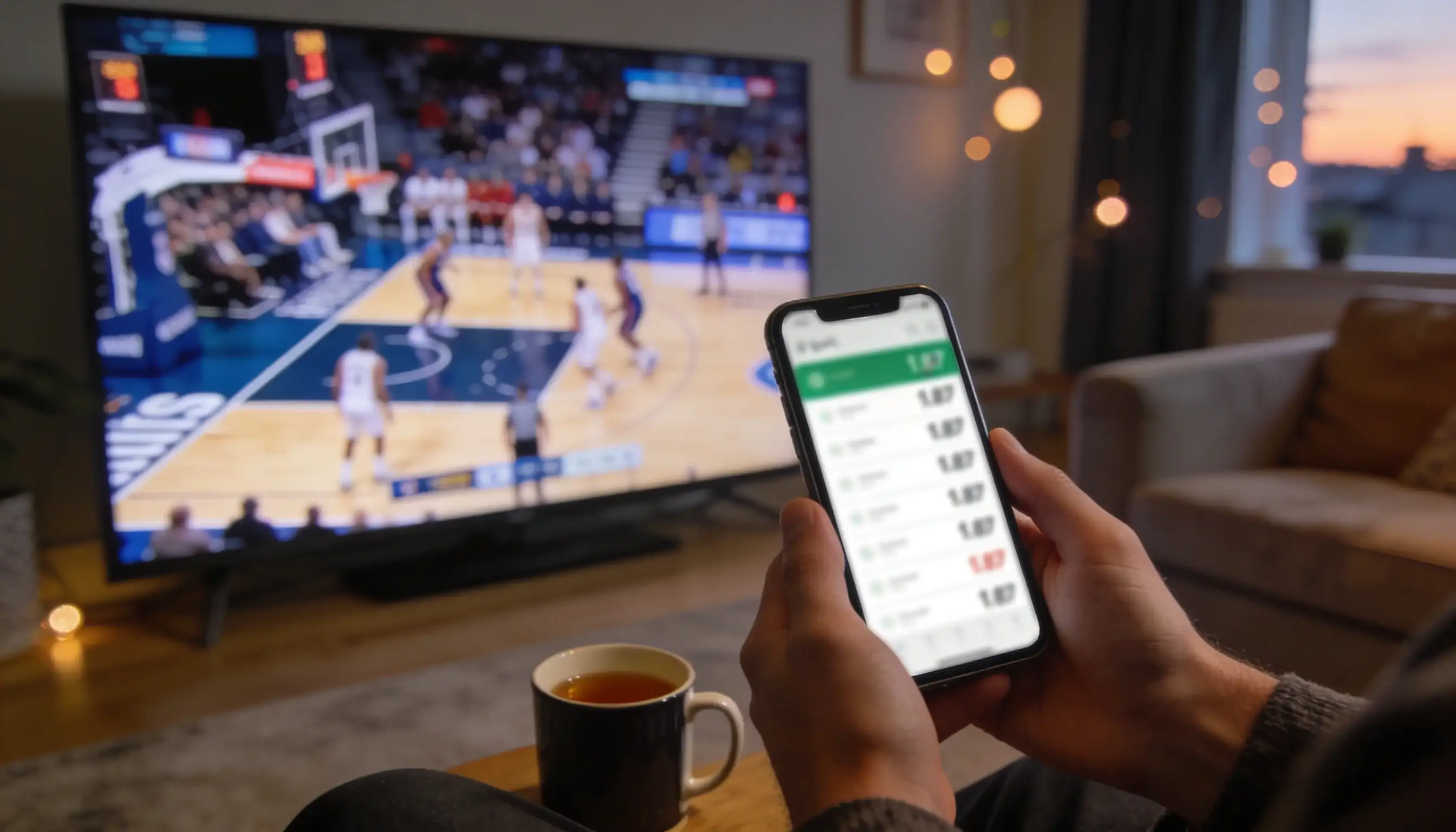
Flutter Entertainment, the parent company of several major UK-facing brands, reported group revenue of GBP 15.91 billion for the full year 2025, a 17% increase on the prior year. William Hill captured 37.83% of PPC advertising clicks in the UK sports betting vertical as of early 2026. These are not recommendations — they are indicators of where market share sits and, by extension, where liquidity and prop market depth are most likely to be concentrated. Larger operators have more incentive to invest in NBA-specific trading teams, broader prop menus, and responsive live markets.
The practical reality for UK punters betting on NBA props is that your best approach is to hold accounts at multiple licensed operators. Line shopping — comparing the odds on the same prop across several sites — is not just a nice-to-have; it is the single easiest way to improve your long-term results without changing anything about your analysis. A half-point difference in a line or a 0.05 difference in decimal odds, repeated across hundreds of bets, compounds into a material edge. A feature-by-feature comparison of UK bookmakers' NBA prop coverage, including SGP builders and live market availability, will help you identify which accounts to prioritise.
Prop market depth
The number of individual player prop markets listed per game varies from as few as 5-10 at some operators to 40+ at those with dedicated NBA trading desks. More markets mean more opportunities to find mispriced lines.
SGP builder availability
Not all UK sportsbooks offer an SGP builder for NBA, and those that do vary in how many prop legs they allow per combination. Some cap at three legs; others allow six or more.
Live in-play props
In-play prop availability is the most inconsistent feature across UK bookmakers. Some suspend player props entirely once a game tips off. Others offer a reduced menu of live lines that update in near real-time.
Settlement speed and transparency
How quickly a bookmaker settles prop bets after a game ends — and how it handles edge cases like overtime or early player exits — matters for bankroll management and for your ability to reinvest funds into the next game's markets.
Responsible Gambling Tools Every UK Punter Should Know
I am going to be direct about something that most betting guides bury in a footer disclaimer: the tools designed to protect you are better in the UK than in any other regulated market in the world, and you should use them regardless of how disciplined you believe yourself to be. I use deposit limits myself. Not because I lack self-control, but because a structural safeguard works when willpower does not — and at 2 AM after a bad beat in a late West Coast game, willpower is unreliable.
The Gambling Commission requires every licensed operator to offer deposit limits, loss limits, session time reminders, and cooling-off periods. These are not suggestions buried in account settings; operators are obligated to make them accessible and to honour them instantly. If you set a weekly deposit limit of GBP 50, the site must prevent you from depositing a 51st pound until the next week begins. No exceptions, no override requests, no "are you sure?" prompts that let you change your mind in the moment.
GAMSTOP self-exclusion: If you need a complete break, GAMSTOP is a free service that lets you self-exclude from all UK-licensed online gambling sites simultaneously. Registration takes minutes, and the exclusion period is a minimum of six months. During exclusion, no licensed operator can accept bets from you, send you marketing, or allow you to open a new account. It is the most comprehensive self-exclusion system available in any regulated market.
The Gambling Commission's executive director, Tim Miller, noted at the Ethical Gambling Forum in 2026 that the Commission has identified a group of vulnerable customers "not currently being identified by other approaches." That statement signals an ongoing tightening of operator obligations. For you, it means the protections available today are likely to expand further in the coming years.
Prop betting carries specific patterns that make responsible gambling tools especially relevant. With hundreds of markets available on a single game day, the temptation to over-bet is constant. When you have analysed five props and found edge on two, the urge to also back the other three "because you already did the work" is real. Session limits and stake tracking help contain that impulse before it becomes a pattern.
UK support resources: GamCare (gamcare.org.uk) offers free advice, support, and counselling for anyone affected by gambling. The National Gambling Helpline is available 24 hours a day, 7 days a week. BeGambleAware (begambleaware.org) provides information and tools for safer gambling. These services are confidential and free.
Bankroll management — setting a fixed betting bank, determining unit sizes, and never chasing losses — is the first line of defence. Responsible gambling tools are the second. The two work together. Neither replaces the other. If you take nothing else from this guide, take this: set your limits before you open a prop market, not after a losing streak forces the question.
Frequently Asked Questions About NBA Prop Bets
What are NBA prop bets and how do they work?
NBA prop bets — short for proposition bets — are wagers on individual player statistical outcomes within a game, independent of the final score. The bookmaker sets a line for a specific statistic (for example, 24.5 points), and you bet on whether the player's actual total will go over or under that number. The bet settles based solely on the player's performance in that statistical category, not on whether his team wins or loses. Props are available on a wide range of categories including points, rebounds, assists, three-pointers made, blocks, steals, and combined stats like PRA (points + rebounds + assists).
What types of NBA player props can you bet on?
The main categories are points over/under, rebounds over/under, assists over/under, three-pointers made over/under, PRA (points + rebounds + assists) combos, blocks, steals, and double-double yes/no markets. Some bookmakers also offer specialty props like first basket scorer, race-to-X-points team props, and quarter or half-specific player totals. Points props are the most popular, accounting for 35-40% of all player prop handle, while specialty categories like blocks and steals are less liquid but tend to carry higher bookmaker error rates.
How do sportsbooks set player prop lines?
Sportsbooks use projection models that incorporate season averages, recent form (typically a 10-game window), minutes projections, pace of play for both teams, the player's usage rate, and the opposing team's defensive ratings in the relevant statistical category. The model produces a projected number, which the bookmaker then adjusts into a line and applies a margin (vig) of 5-8% on standard props. The line is set so that the bookmaker profits regardless of outcome, though the large number of prop markets on any given game day means some lines are priced less accurately than others.
Do NBA prop bets include overtime?
At most UK-licensed bookmakers, standard player props include overtime unless the specific market rules state otherwise. This means a player who is one rebound short of the over line heading into overtime gets the benefit of the extra period. The exception is quarter and half props, which settle on the stats accumulated during that specific period only. Settlement rules vary between operators, so it is worth checking the specific terms for NBA props at your bookmaker before placing a bet — particularly on close lines where overtime could be the difference between a win and a loss.
What happens to my prop bet if a player gets injured during the game?
The answer depends on the bookmaker's settlement rules and how much of the game the player completed. Most UK sportsbooks void a player prop if the player does not participate at all (DNP). If the player starts but leaves early due to injury, policies diverge: some operators settle the bet as it stands at the point of exit, some void if the player fails to complete a minimum threshold (often the first half or a set number of minutes), and others settle all bets regardless of playing time. The variation between bookmakers is significant enough that checking settlement terms before you bet is a necessary step, not an afterthought.
How are NBA prop bet odds displayed differently in the UK compared to the US?
UK bookmakers display odds in decimal format (e.g. 1.87), which shows your total return per unit staked — including the stake itself. US sportsbooks use American format (e.g. -130), which shows either how much you need to stake to win 100 units (negative numbers) or how much you win on a 100-unit stake (positive numbers). To convert negative American odds to decimal, divide 100 by the absolute value and add 1. To convert positive American odds, divide the number by 100 and add 1. Fluency in both formats is essential for UK punters who consume American-produced prop analysis, as the odds on your UK screen will look different from the numbers quoted in the tip.
What is a same-game parlay and how does it work with player props?
A same-game parlay (SGP) — known as an accumulator in UK betting terminology — combines multiple selections from a single game into one bet. All legs must win for the bet to pay out. You might combine a guard's points over with a centre's rebounds over and the game total under. The potential payout is higher than any individual leg, but so is the bookmaker's margin: SGP margins typically run 15-25% above the sum of the margins on the same legs placed individually. The SGP builder adjusts for correlation between legs, and that adjustment is not transparent — you cannot easily verify whether the combined price is fair. SGPs are best approached as an occasional entertainment product rather than a core strategy.
Related posts
NBA Prop Bets vs Moneyline and Spread: a Side-by-Side for UK Punters

NBA Race to X Props and Game-Level Propositions: Beyond Player Markets